The basics of recovering a pool table. Pool table felt replacement.
There are no standard instructions on the market for pool table cloth recovering. The information provided here is intended to help you recover your pool table. There are many different brands and styles of pool tables so the information here is intended as a very basic recovering guide for you DIYers. Keep in mind that pool table work, like pool table felt replacement, is a very specialized field and professionals get their experience by doing hundreds of professional pool table jobs. Brands and styles of pool tables are different but the basic concept in initial covering or recovering is pretty much the same with regards to working with felt and slate. Most pool table mechanics have their own style of work but the end results are usually the same. It looks beautiful and is durable.
Venus Pool Table Installation Time Lapse. Paragon Game Furniture. Billiard and Pool Tables Toronto
Enjoy your pool game again after pool table recovering

We do not charge for this information and we do not guarantee any results as table recovering is generally best left to professionals, however, if you are handy and want to have a go at saving anywhere from $150-$300 in labor charges then the info here may help you.
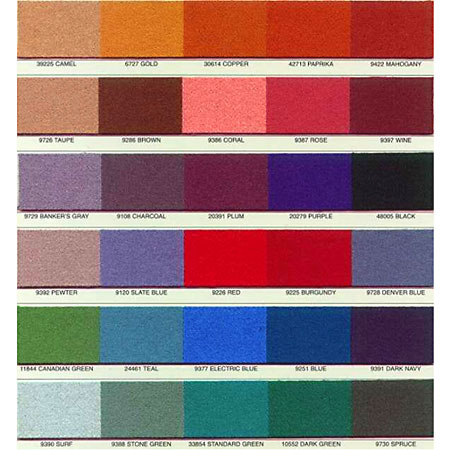
How do I recover my pool table felt?
Before you start pool table repair, try and get a good feel for how the job needs to go by examining how the old cloth was applied to your rails and slate. Don’t strip off the old cloth until you have your new cloth and are ready to start the job. Start with the rails and do 1 rail at a time. This way you have the other rails to use for reference. Use the pool table as a work bench since it is a flat surface and there’s no need to worry about the old bed cloth since it will be replaced. Take your time and always be aware of where you make cuts on the new cloth. It’s a good idea also to keep your tools on the floor, a chair or in a tool box so you don’t do any accidental damage to the new cloth you are applying.
Tools and Supplies You May Need for Pool Table Recovering
- Light duty staple gun (non-electric Craftsman, LittleShooter or Arrow JT21 work fine)
- 1/4″ light duty staples
- Rubber mallet or hammer and flat pounding block for seating featherstrip
- 2″ Seam roller if the featherstrip is flexible plastic
- Awl or thin flat screwdriver and needlenose pliers to pull staples
- Razor blades and handle
- Contact Adhesive if glueing cloth to slate – 3M Super #77 or #90
- 3/8″ Socket set with extension handle
- Flat and Phillips screwdrivers
Additional Items If Also Setting Slates
- Level
- Heavy duty Flat or Phillips screwdriver for slate screws
- Shims or wedges for slate leveling
- 4″ putty knife for applying joint compound to slate seams
- Small tub of DAP qwik-dry joint compound for slate seams or Beeswax (you will need a propane torch to melt the beeswax).
- Alternately you can use bondo which may require some finish sanding.
**NOTES**
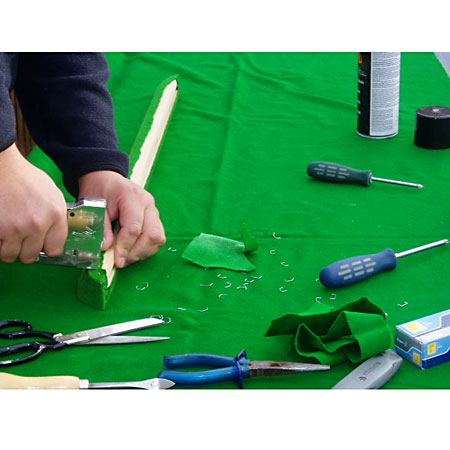
For the bedcloth you can staple if the slate has a wood backing or glue. If the bedcloth was previously stapled then use staples. If the wood is torn up and won’t hold staples then use glue, OR, if you just want to use glue that is fine too. In the pictures the bedcloth is being installed using glue so if you are going to use staples just substitute.
For the rails, note that you will have 4 rails with 1 flat side (side pockets) and 2 rails where both ends are angled (end rails). For the side pocket rails, start at the angle end and work continuosly towards the flat end. For the end rails, start at 1 angle end and go 1/3 towards the other end. Then go to the other angle end and do the same. Now staple in the middle and work your way to each end.
Rails – Pool Table Repair
Do 1 rail at a time, remove the old cloth, apply the new cloth. Take your time. If you crack a wooden feather strip while removing it, that’s ok, you can still use it. Try to keep it in 1 piece if possible and be careful when reapplying it. If using flexible feather strip, it may stretch a bit when being reapplied so it is ok to snip the end to make it fit in the channel. Use a wallpaper seam roller to install. Regardless of what type featherstrip you use the idea is to have it flush with the top of the rail. Before flipping the cloth and rail over for stapling make sure there is no debris that will get caught under the cloth otherwise you will feel it in the cloth when done.
A common question is how tight do I pull the cloth? The answer is not so tight that you create ripples in the cloth, yet tight enough to eliminate any looseness. Also, a common mistake is not putting the staples close enough to each other. Spreading the staples too far apart may result in ripples showing up later. You will want to use 1/4″ staples. The average distance between staples is about 1″ apart.
The bottom line when covering rails is to eliminate all wrinkles where the cloth will be showing. It doesn’t matter underneath the rail, wrinkle as much as you like, but on top it should be smooth and tight (no wrinkles when you run a finger over it). If you make a mistake or the cloth isn’t going on right, unstaple and re-work the rail. Even professionals sometimes find themselves removing some staples in order to get it right. If there is any one area where you should take your time, it is on the rails. Getting these right will make your table look good and play the way it should.
Slate Bed
A few things to consider before applying the bedcloth. First, make sure your table is level. Make minor adjustments as necessary using wood shims or playing cards. Check the seams in your slate. Whether you use joint compound, beeswax, bondo, etc. the seams should feel smooth when running a hand across the seams. You may have to rework the filler to get this right. Work quickly and remove any excess filler so that sanding is not necessary. A putty or razor works well for this.
If there are any slate screw holes in the middle of the table make sure they are filled and smooth. The slate screw holes around the perimeter of the slate do not need to be filled as long as the holes are “completely under the rails”. Tip: minor slate-leveling adjustments can be made by adjusting the tightness or looseness of the slate screws. Be very careful when working with slate screws as they tend to strip the heads rather easily and will be extremely difficult to remove if stripped.
Use a damp cloth and wipe the dust and residue off the slate. When dry, use the palms of your hands to sweep the whole slate bed again. This way you can feel for bumps and indents in the slate and remove or repair any imperfections before applying the bedcloth. You certainly don’t want to feel bumps and holes once you have the whole bedcloth installed.
Applying Bedcloth
Work on 1 edge of the table at a time, starting at 1 end, then the other, then each side. There are 2 ways to apply the bedcloth, with staples or with glue. Either method works as well as the other and you are best to use the manner previously used on your table. Stapling is a bit faster as long as your table has a wood slate liner that holds the staples but if the table is really old and has been recovered many times you may be better off using glue. If using glue, try to keep it off your fingers since any glue residue may eventually wind up on your playing surface as you work with the cloth. Always be aware of where overspray will go.
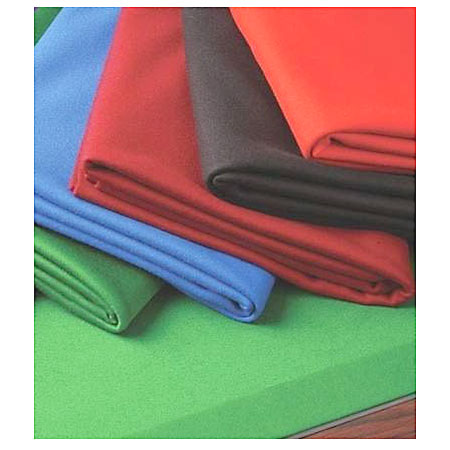
If using glue, only spray the verticle edge and about 1″ on top of the slate edge. Also spray the cloth where it will meet the slate. Put paper or cardboard on the felt so you don’t get overspray on the rest of the cloth. Work 1 side or end at a time. After you spray, allow about 3 minutes of dry time before doing anything. 3M #77 & 90 is workable for about 5 minutes so if the cloth doesn’t go on the way you want, lift that section off and reapply. Don’t use more glue unless the cloth isn’t sticking to the slate. Run a straightedge, a seam roller or your hand along the edge after you apply the cloth to smooth out any air bubbles.
Regardless of using glue or staples, start at 1 end of the table. Then move to the other end, give the cloth a good stretch and apply. Smooth out the cloth and apply 1 long side without any stretching. Then when you apply the other side give it a good stretch. The cloth is applied correctly if you can run your hand over the bed and there is no looseness or rippling in the bedcloth once it is secured on all 4 sides.
Be very careful when cutting your pocket areas. Think twice, cut once. In the pocket area, feel for the bottom edge of the slate with your thumb. This is where you start your cut. Make it a little shallow since you can always cut a little more if necessary. Once all your cuts are made make sure the cloth (looks like fingers) will roll under the table without being too tight. If too tight, cut a bit more into the cloth. Now you can staple in your pocket area, or if using glue, spray the verticle slate edge and 1″ under the slate. Also spray the cloth “fingers” from below. Roll the cloth fingers under the slate and smooth out.
Once the bedcloth is installed, cut holes in the cloth for the rail bolts. Feel for the holes from under the slate, then cut the holes out. There are generally 3 rail bolt holes for each rail.
When installing the rails, loosely tighten all rail bolts first. Then run your eyesight down each long side and make sure both rails are straight. Now check the dimensions with a tape measure from side rail to side rail and end rail to end rail. Measure point to point where the ball would hit the rails. Dimensions should be 39″ by 78″ for a 7′ table, 44″ by 88″ for an 8′ table, 50″ by 100″ for a 9′ table. Make any adjustments necessary and then eyeball the long sides again to make sure both rails are straight. When satisfied, tighten the rail bolts. Be careful not to overtighten the rail bolts or you will drive them right thru the rail.

You won’t have to worry about a thing – we’ll take care of everything for you.
Paragon Interiors is proud to have serviced hundreds of Billiard and Pool Tables for over 35 years.
Our Senior Billiard Technician was extensively trained in our own facility in 1991. We would be most pleased to offer his skills for a variety of your service requirements.
How to refelt a pool table properly?
To keep your pool table looking its best, it’s crucial to properly maintain it. Therefore, to ensure a durable finish and felt, make sure to clean and dust your pool table frequently after playing and using the proper cleaning supplies. Additionally, replace the felt right away if you see any signs of wear or damage to stop further harm from happening. Of course, you should never hesitate to ask for assistance if you ever feel that you need it in order to recover or replace the felt. Call us at 416-635-8080. Your pool table will remain in great shape for many enjoyable and entertaining years with the proper care and upkeep!
Last but not least, make sure to always seek the advice of a professional for assistance if you’re ever unsure about any stage in the procedure for recovering or replacing your pool table felt. A pool table technician will be able to give you all the knowledge and assistance you need to finish the project.
So stop waiting and begin repairing or replacing your pool table felt right away! You may resume entertaining friends and family with a lovely, updated, and upgraded pool table in just a few simple steps.
Good fortune!

Pool table recovering and pool table felt replacement in Toronto
Tips for Recovering a Pool Table
Recovering your pool table is a great way to bring new life and energy to your game room. But it can be an intimidating process if you’ve never done it before. Here are some tips to help make the job easier:
- Choose high quality felt and cloth suitable for use in a pool table. Billiard felt is specially designed for the game and should be used.
- Measure your pool table to make sure you have enough material to cover it properly.
- Take time to prepare the surface of the table, making sure it’s clean and free from any debris or dirt that could compromise the integrity of the new felt.
- Make sure you have all the necessary tools and materials before you begin. This includes felt, sandpaper, a staple gun, clamps, a trowel or spoon for smoothing out bumps in the felt.
- Take your time to ensure that each piece of felt is cut and fitted properly around all edges of the table.
- Use a staple gun to secure the felt in place and make sure each staple is placed firmly for a tight fit.
- Smooth out any bumps or wrinkles in the felt with a trowel or spoon before you begin playing. This will help ensure that your pool table performs to its utmost potential.
Check out the links listed below for additional advice on pool table maintenance and information on recovering and replacing felt. Purchasing pool tables is an investment.
If you are looking for “pool table recovering near me” in Toronto area, please call us at 416-635-8080.
Learn More About Pool Tables
Call us 416-635-8080 today and let us do the work!